
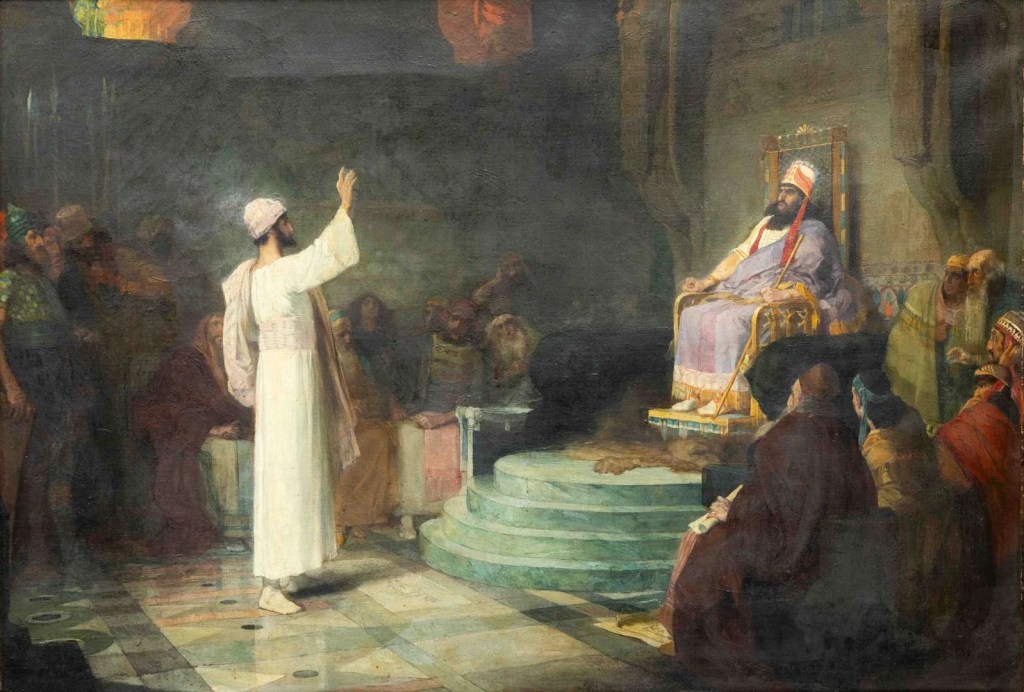
Daniel interpreting the dream of King Nebuchadnezzar, by Pieter Josselin de Jong
37 Your Majesty, you are king of kings. The God of the heavens has given you sovereignty, power, strength, and glory. 38 Wherever people live—or wild animals, or birds of the sky—he has handed them over to you and made you ruler over them all. You are the head of gold.
39 “After you, there will arise another kingdom, inferior to yours, and then another, a third kingdom, of bronze, which will rule the whole earth. 40 A fourth kingdom will be as strong as iron; for iron crushes and shatters everything, and like iron that smashes, it will crush and smash all the others. 41 You saw the feet and toes, partly of a potter’s fired clay and partly of iron—it will be a divided kingdom, though some of the strength of iron will be in it. You saw the iron mixed with clay, 42 and that the toes of the feet were partly iron and partly fired clay—part of the kingdom will be strong, and part will be brittle. 43 You saw the iron mixed with clay—the peoples will mix with one another but will not hold together, just as iron does not mix with fired clay.
44 “In the days of those kings, the God of the heavens will set up a kingdom that will never be destroyed, and this kingdom will not be left to another people. It will crush all these kingdoms and bring them to an end, but will itself endure forever. 45 You saw a stone break off from the mountain without a hand touching it, and it crushed the iron, bronze, fired clay, silver, and gold. The great God has told the king what will happen in the future. (Daniel 2:37-45; CSB)
This speech is by a young Jewish man named Daniel, given to the Babylonian king Nebuchadnezzar some time in the 6th century BC. In it, Daniel offers an interpretation of a disturbing dream the king had recently experienced. It is an especially important part of the book because it establishes this young Jewish man as a genuine prophetic figure. Daniel’s speech take place in pagan Babylon because the Babylonians have conquered Jerusalem and brought some of most promising Hebrews back to their homeland to assimilate them into their own culture.
In chapter 1 of this book, there is an initial clash of values, where Daniel and his young friends refuse to eat some of the food offered to them. In chapter 2, King Nebuchadnezzar has a bizarre and disturbing dream. In desperation he seeks out someone who has the ability to interpret what the dream really means. No one in his kingdom seems up to the job.\
Enter Daniel.
What you see above is the interpretation he gives. It is a stunning, verifiable prophetic utterance. And it should be formative for any Christian in establishing their eschatological outlook.
Escha-what-ogy?
As I have explained in a previous post, Eschatology is a branch of Christian theology concerned with the unfolding of God’s purposes throughout history, often with a focus on what will take place in the future, especially at the end of history. Having held a range of eschatological views throughout my life, I have finally discovered the beauty and coherence of a view called postmillennialism. It is the perspective that Christ’s glorious reign over all things will become gradually more evident over time as the Church preaches the gospel and works in the world for God’s glory. Instead of the state of the world getting continuously worse, postmillennialism believes that as the Great Commission is carried out, the world will gradually become a better place. And instead of the church diminishing in its size and influence, there will be growth and substantial progress in cultural transformation across the world. Despite the fact that Christians can and will suffer and be persecuted, Christ will gradually win over the world he loves, so that a majority of people repent, believe, and walk in his ways. At the end of this process (called ‘the church age’), Christ will victoriously return – not to mop up an utter mess, but to complete the redemption of his world.
But a few qualifications are in order.
This positive outlook on the future causes some people to raise all sorts of objections. So, just for clarity, Postmillennialists (generally) don’t believe that . . .
- The growth and influence of the church will be uniform. There will always be parts of the world that respond to the gospel more than others. And time will show that the church will go through ups and downs, but the overall trajectory of gospel progress will trend upwards even if there are periods of apparent contraction.
- Before Jesus comes back, we will usher in a time where there is NO suffering or persecution. Until Christ returns, there will always be ways in which people suffer and struggle. There will always be times when Christians fail, and fall into temptation. And there will always points of tension with non-Christian values and anti-Christian sentiments in various parts of the world, to varying degrees. It’s just that these will be far less prevalent than what we experience now.
- Following Jesus Christ in this world will be easy and bring abundant personal, material and psychological benefits to all Christians. Until the consummation of all things, Christians living in this world will be subject to all the ‘normal’ things that sinners face – suffering, doubts, temptations, and conflict. While we expectantly work and pray for a growth in gospel influence across the world, there will always be things to pray about and trust God for.
The postmillennial perspective calls Christians to a joyous, confident faith – a faith without fear or fantasy. It’s about living with bold but humble confidence that we are on the right side of history, because we belong to the king who rules over history! And throughout history, the reality of his reign will become wonderfully evident and extensive.
But I know what you are thinking right now. You’re probably saying to yourself, “Surely the Bible doesn’t teach anything like that!?”
Actually, despite what you’ve been told, it does.
This post is the first of many attempts to show you that postmillennialism might not be as crazy as it first sounds. In fact, my hope is to show you why it is the eschatological perspective to be preferred.
Identifying the Kingdom that will never end
In first half of Daniel chapter 2, Nebuchadnezzar has an upsetting dream. He sees a strange statue comprising of various materials – a gold head, silver chest and arms, stomach and thighs of bronze, legs of iron and feet of both iron and clay. Then, suddenly, a “rock” of divine origin (2:34) struck the feet of the statue, and the whole thing collapses and falls into pieces. Even the pieces of the statue disintegrate, and it is all completely blown away by the wind (2:35). Then the rock which has destroyed this impressive statue transforms from being a rock to become “a great mountain” which “filled the whole earth” (2:35b).
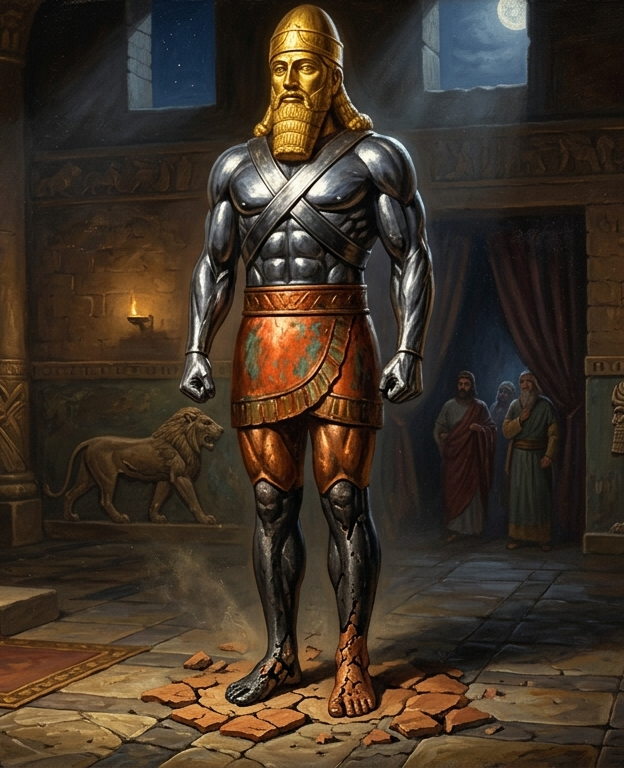
In the second half of chapter 2, Daniel’s interpretation of Nebuchadnezzar’s dream reveals the statue represents a sequence of kingdoms that rise and eventually fall. There are five kingdoms mentioned in total: four temporary, and one permanent. Matching these kingdoms to known historical kingdoms has proven very controversial. I will leave that discussion aside for the moment. But it is possible to identify three main kingdoms mentioned by Daniel.
The first kingdom we can identify is the easy one. Daniel explains that the first kingdom represented in the king’s dream is Nebuchadnezzar and his Babylonian kingdom. Daniel tells him:
37 Your Majesty, you are king of kings. The God of the heavens has given you sovereignty, power, strength, and glory. 38 Wherever people live—or wild animals, or birds of the sky—he has handed them over to you and made you ruler over them all. You are the head of gold.
Nebuchadnezzar rules over a kingdom so large that Daniel can express it in terms of global extent. It is hyperbole offered to honour the king. After all, Babylon was no ordinary place. It was powerful, massive, and organised. As Daniel interprets Nebuchadnezzar’s dream, the sequence of successive kingdoms which will rise and fall starts with the one he is currently in – Nebuchadnezzar’s kingdom! Easy.
There are two more kingdoms we can identify with confidence. Let’s consider the last kingdom in Nebuchadnezzar’s dream. At the end of the sequence, we learn about another kingdom which will be established by God himself. A kingdom that will, unlike all the others in the dream, last forever.
44 “In the days of those kings, the God of the heavens will set up a kingdom that will never be destroyed, and this kingdom will not be left to another people.
Whenever the Old Testament prophets speak of this coming kingdom, it’s permanence and prosperity are defining characteristics. In a famous ‘Christmas passage’ found in the prophet Isaiah, it is prophesied,
For a child will be born for us,
a son will be given to us,
and the government will be on his shoulders.
He will be named
Wonderful Counselor, Mighty God,
Eternal Father, Prince of Peace.
The dominion will be vast,
and its prosperity will never end.
He will reign on the throne of David
and over his kingdom,
to establish and sustain it
with justice and righteousness from now on and forever.
The zeal of the Lord of Armies will accomplish this. (Isaiah 9:6-7)
A fair and consistent reading of both the Old and New Testaments points to the kingdom rule of God established by Jesus as being centre-point of God’s promises and plans. It is the kingdom established by God which will never end. And Jesus is the permanent, glorious king of this Kingdom.
In the gospel of Mark, some of Jesus’ first words are
“The time is fulfilled, and the kingdom of God has come near. Repent and believe the good news!” (Mark 1:15)
Jesus came to inaugurate and establish God’s permanent, imminent rule on the earth. And when questioned by the Jewish leaders, Jesus affirmed the reality of his kingship:
Then the high priest stood up before them all and questioned Jesus, “Don’t you have an answer to what these men are testifying against you?” But he kept silent and did not answer. Again the high priest questioned him, “Are you the Messiah, the Son of the Blessed One?”
“I am,” said Jesus, “and you will see the Son of Man seated at the right hand of Power and coming with the clouds of heaven.”
Then the high priest tore his robes and said, “Why do we still need witnesses? You have heard the blasphemy. What is your decision?” They all condemned him as deserving death. (Mark 14:60-64; CSB)
The high priest was furious that Jesus would claim to the be the Messiah – the long-promised King in the line of King David. Again, Jesus will not become king thousands of years in the future. His kingly reality is breaking into the world right before them, whether people like it or not.
This helps us understand Daniel’s interpretation of Nebuchadnezzar’s dream. When Daniel says there is a kingdom coming that will never end, he is referring to the kingdom established and ruled by Jesus Christ.
The Kingdom established in the context of the Roman Empire
We have identified two of the kingdoms referenced in Daniel’s interpretation. The first is the easiest: the Babylonian empire. The last kingdom on the list is just as easy, as long as you understand the broader salvation-historical arc of the Bible. It’s the reign and realm of Jesus Christ, the Son of the Blessed One. It’s the only kingdom in the Bible that God promises will be established and made permanent by him.
So far, so good.
Establishing the last kingdom mentioned by Daniel leads us to identify another kingdom on the list. The second-last kingdom mentioned. To recap, here is what he said:
40 A fourth kingdom will be as strong as iron; for iron crushes and shatters everything, and like iron that smashes, it will crush and smash all the others. 41 You saw the feet and toes, partly of a potter’s fired clay and partly of iron—it will be a divided kingdom, though some of the strength of iron will be in it. You saw the iron mixed with clay, 42 and that the toes of the feet were partly iron and partly fired clay—part of the kingdom will be strong, and part will be brittle. 43 You saw the iron mixed with clay—the peoples will mix with one another but will not hold together, just as iron does not mix with fired clay.
44 “In the days of those kings, the God of the heavens will set up a kingdom that will never be destroyed, and this kingdom will not be left to another people.
The fourth kingdom mentioned in Daniel’s interpretation is the strongest in the sequence up to that point. Though the imagery suggests this kingdom will start strong and become brittle at a later point, it is clear the during the span of this fourth kingdom, God will establish his eternal kingdom. Since it is a matter of historical fact that Christianity emerged and spread within the context of the Roman Empire, we can know with confidence that the fourth kingdom mentioned by Daniel is Rome.
If God’s eternal kingdom is established at a point of time after the Babylonian Empire and its successors have fallen, and if there is an especially powerful ‘kingdom’ that is in power when God does this, the fourth kingdom mentioned by Daniel must be the Roman Empire.
This is important because the establishment of the Messiah’s kingdom is not a matter for the distant future. It was to take place ‘in the days of those kings’ – a few empires down the historical track from Babylon. That can only be the Roman Empire. Not a future kingdom that emerges in 1,000AD or 2,000AD. But when Rome ruled. In the days of those kings.
And that’s exactly what happened.
So aside from showing Daniel to be a man with truly prophetic insight, what does this interpretation show us? It shows us the permanent Kingdom established by God emerges onto the stage of human history with the death, resurrection and ascension. This kingdom prevails – not just at the end of time, but in the time leading up to the end of time too. Remember what Isaiah promised, “The dominion will be vast,
and its prosperity will never end.”
The Kingdom that replaces all others
Most usually in the Bible (and outside the Bible), a kingdom is a state of affairs where a king (or queen) exercises their rule (power and authority) across a defined realm (a territory). A kingdom is the rule and realm of a king. That was true of Nebuchadnezzar. The sprawling Babylonian Empire was his realm to rule. All of it. Everything – from the daily lives of its citizens, to the economy and military – was under his rule.
The same was true for the other kingdoms in Nebuchadnezzar’s dream. Each of them had a kingly figure who ruled over a realm. That included the Roman Emperor Tiberius, who ruled during the ministry, death, and resurrection of Jesus Christ.
But in raising Jesus from the dead, and glorifying him at his ascension (his return back to heaven), God has ushered in the new rule of God – that promised, permanent kingdom. The ascension of Jesus and the outpouring of the Holy Spirit heralded that the “rock” of Nebuchadnezzar’s dream had indeed collided with the earthly state of affairs. The Roman Empire – which will at first oppose the church – will eventually adopt it as its official religion. And Rome’s power will eventually break down, just as Daniel foresaw. But the Kingdom of Jesus will remain forever.
But the Kingdom of Jesus isn’t a static, purely ‘spiritual’ rule which is restricted to the well-meaning hearts of a small group. It grows and impacts the world that those other powers once dominated. Remember that this ‘rock’ that becomes a mountain that fills the whole earth. In Nebuchadnezzar’s dream, the rock doesn’t hit the statue and remain the same size. It grows gradually and fills the whole earth through time.
The same is true of the rule and realm of Jesus. His realm is the whole world, and the rule of Jesus grows as people come to faith, and the gospel shapes churches, continents and cultures. It’s not a ‘rock’ that becomes a slightly bigger rock, and only becomes at mountain at the very end of time. It grows to become a mountain throughout the course of human history. And it eventually fills the whole earth.
This is not to say that the utility of political power is abolished. In the midst of economics, military power, and the imperfect striving of human beings, God is growing his kingdom. And that growth will displace the powers that once ruled this place.
Daniel said,
44 “In the days of those kings, the God of the heavens will set up a kingdom that will never be destroyed, and this kingdom will not be left to another people. It will crush all these kingdoms and bring them to an end, but will itself endure forever.
Notice the wording. It’s not that the kingdom of God shows up and plods along while the kingdoms of this world march ever on without God. No, the kingdom of God brings them to an end. The kingdom of Jesus will grow, and bring all those standing in defiance of God to an end. Not just at the end of time, but through time.
The ‘crushing’ of these other kingdoms isn’t through military might, but by the word of God and the power of the Holy Spirit, as the church carries on with the Great Commission to make disciples of all the nations. Through time, the reign and realm of Jesus becomes vast and increasingly evident.
Not the third draw in the kitchen
In most modern kitchens, there is usually an arrangement of four drawers in the one spot. The top draw has the cutlery. The second draw down has the spatulas and mixing spoons. And the third draw down has a weird mix of things – maybe a few odd shaped items. Maybe some recipes and other things. It’s the weird draw. And for many people, that’s how they see postmillennialism – something we pulled out of the weird draw. It’s a weird mix of . . . whatever.
But my hope is that you will come with me, and be open to reading the Bible with new eyes. I hope you see what the word of God says about the work of God in history. It’s a bigger, bolder story than you might be used to. And that might feel weird. That’s OK. We’re all used to pessimistic Christianity.
Maybe the good news about Jesus is ‘gooder’ than we’ve been told.


You must be logged in to post a comment.