
I recently stuck my oversized nose into the comments section of a Facebook post by historian and social commentator Stephen Chavura. He had reposted an article about ‘wokeism’ from a Christian perspective, and it drew the following response from a chap named Marcus:
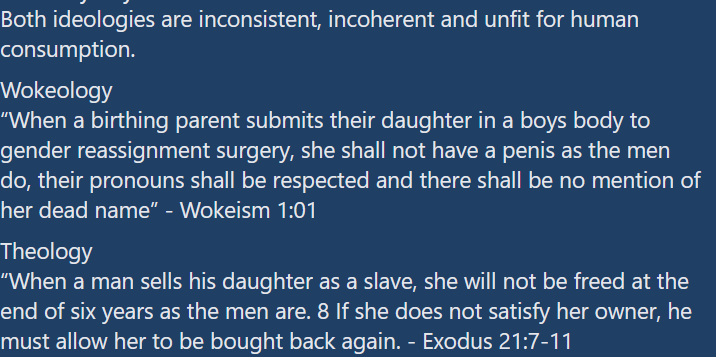
According to Marcus, both “Wokeism” and Christianity are inconsistent, incoherent, and unfit for guiding our moral and social order. Reading the quote he provided from the book of Exodus (interestingly quoted from the New Living Translation), it’s not hard to see his concern. The “what about slavery?” question has been around for a long time.
I responded to Marcus by directing to some online commentary about the passage he’d quoted. He responded:
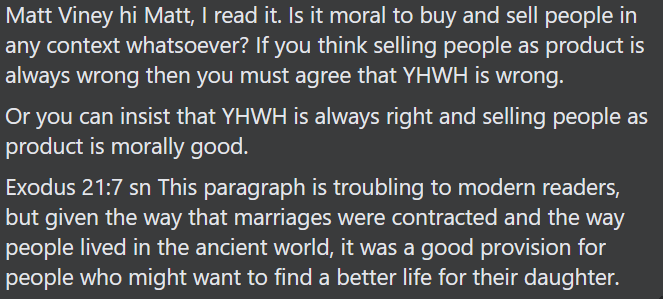
Marcus asks a good question: “Is it moral to buy and sell people in any context whatsoever?” He presents a moral and theological quandary: either (1) selling people ‘as product’ is always wrong, and therefore God got it wrong on that point, or (2) God got it right and selling people is morally good. I’m not sure the moral questions surrounding slavery can be reduced to these two options. The topic is more complex and nuanced than that. I hope to show why.
I promised Marcus I would provide a response to the issues he raised. In fact, given the nature of the topic, I’m going break up my response into two or three blog posts. I am not doing this to get people to visit my blog – I’m actually not interested in people visiting it, really. I use my blog to post stuff I’m thinking about, a bit like an online notebook or journal. However, Marcus’ very legitimate concerns about slavery in the Bible have got me thinking, and since there is a fair bit of material to cover, I’m going to post it all here (eventually) instead of on Facebook.
Let the festivities commence.
HOLDINGS ONE’S PROVERBIAL HORSES
The topic of slavery is massive. Over the years, hundreds of books and scholarly works have focused on slavery in its various forms throughout history. It’s an emotional topic too, as the very thought of people being ‘owned’ by other people seems abhorrent. The question of whether the God presented in the Bible condones slavery is of great importance, because if God truly sees slavery as an outright moral good, critics of the Christian faith appear to have a very good point.
But does the God of the Bible truly see slavery as morally good? Do the instructions given in the Bible pertaining to slavery seek to encourage it? Why doesn’t God strictly prohibit slavery in all instances? These are the main questions I want to tackle, but we need to acknowledge that these are not questions we approach from some neutral space. Since the veracity of the Bible and the Christian God is in view, there is much at stake. Those who dislike Christianity would be only too happy to find solid evidence that the Bible is a barbaric, outdated book. Those who have put their trust in the God of the Bible will seek to defend the Bible. On all matters of major importance, no one comes to these questions from a truly neutral stance. Including me. Though, I hope to offer some kind of reasonable case, and evidence it as I go (references will appear at the end of the post).
But before we dig into some of the meatier aspects of our questions about slavery, we need to remember how complex the issue of slavery in the ancient world is. This subject intersects with questions of historiography, cultural anthropology, psychology, theology, politics, and economics. A simplistic, impressionistic approach won’t work here. We must take our time and think as clearly as possible.
Instead of charging into this one, let’s hold our proverbial horses and get a sense of the wild terrain in front of us.
A HARD LIFE: SLAVERY, LIFE AND DEATH IN THE ANCIENT WORLD
It is well known that slavery in the ancient world was widespread. By ‘the ancient world’ I will be referring mainly to the time between 3,000BC – 500AD. Evidence of slavery has been found in many different socio-cultural settings, from hunter-gatherer populations to simple agrarian societies, all the way up to powerful states and large empires [1]. Ancient records attest to the use of slavery among the Assyrians, Egyptians, Phoenicians, Persians, Indians and Chinese – not to mention the enormous use of slavery in the Greek and particularly Roman empires [2]. According to the British Museum, about 10% (but possibly up to 20%) of the Roman empire’s population in the first century AD were slaves (meaning between 5-10 million people were enslaved across the vast empire) [3].
If slavery was common in the ‘ancient world’, what factors might have driven this? Again, the answer is complex, but let’s get a sense of it by thinking about life mostly in Africa and the Ancient Near East. In terms of life expectancy, during the time of the Roman Empire the average life expectancy for males in Egypt was 22-25 years, and females was 35-37 years [4]. For ancient Sumerians, the average age at death was around 30 years for males and 28 years for females [5]. Assuming a somewhat uniform pattern of life expectancy across the ancient world, it is fair to say that people – especially the poor – did not live long. The average person could expect to live between 20-40 years.
Low life expectancy in the ancient world was due to many factors, one of which was war. Warfare was very common throughout the ancient Near East, and most people would have seen warfare firsthand at some point in their life. Almost all major aspects of life in the ancient Near East were affected directly or indirectly by violent conflict [6]. Furthermore, the obvious lack of effective medical care meant that ancient populations were susceptible to high levels of peri-natal morality, along with waves of illnesses and plagues. The Antonine Plague which spread across the Roman Empire in the second century AD was killing more than 1000 people a day at one point [7]. If only they had disposable masks to protect them!
In terms of wealth distribution, it goes without saying that most people were quite poor, often only able to earn, grow, or barter enough food and drink to survive. While wealth levels varied from country to country and fluctuated over time, there is good evidence that there was a general pattern in which ‘the rich got richer and the poor got poorer’ [8]. Most of the wealth became centred in cities where provincial rulers resided, and life in ‘the suburbs’ could be just as difficult as those living in rural areas [8]. In terms of how people earned a living, much of work life in the ancient Near East (ANE) centred on agricultural practices, the herding of animals, and involvement in building or mining projects [9]. As nation states solidified and there were larger population centres, much ‘work’ also centred on tasks related to life within these emerging towns and cities. As population centres grew, increasing social and economic complexity often created greater capacity for mass chattel slavery [1].
WHAT KINDS OF SLAVES WERE THERE? AND WHERE DO YOU EVEN GET SLAVES?
Slaves don’t grow on trees, and not all kinds of slavery were the same. We also need to bear in mind that ‘slavery’ in the ANE is a term used relatively to describe one’s relationship to any hierarchical superior. Thus, a household may own slaves, all citizens could be regarded as slaves/servants to the king, and all humans are, in a sense, slaves to the deities [10]. While some forms of slavery were contractual, temporary, and more akin to being a ‘servant’ or free workhand, “permanent slaves” were acquired in different ways:
(a) Capture. Instead of killing your defeated foes, you could enlist them in forced labour to help you with agricultural work or construction projects. This source of slavery is very common and well attested as far back as 3000 BC [12].
(b) By purchase. Slaves, being a ready source of labour, could be purchased from other slave owners or merchants. In the Biblical account of the Hebrew patriarch Joseph, he was sold to an Egyptian high official by his captors (see Genesis 37:36; 39:1) [11].
(c) By birth. Children born to slave parents became ‘house born slaves’. Accounts of this are found in the Bible and in ancient Mesopotamian sources [11].
(d) As a payment for debts. Debtors who went bankrupt or were unable to service their debts could be sold into slavery as recompense. There seems to be no ‘plan b’ for bankruptcy – if you didn’t have the money or a wealthy benefactor, the debt had to be recovered. If all you had of value was you, then that was the ‘payment’ [11]. Slave labour = money and/or food for the slave owner.
(e) Abduction. Sometimes private citizens were kidnapped and forced into labour by their captors, completely outside the context of war or debt recovery. Such a crime was usually punished very harshly in most ANE cultures [11].
(f) Self-sale. Sometimes a person would volunteer to become a slave due to socio-economic desperation. If you don’t have a family to provide for you, and you have no reliable means for acquiring money or food, then selling yourself to someone else would be your only shot at survival. Desperate people do desperate things [11]. If your slave master was a reasonably agreeable chap, you would at least have food, shelter, and a measure of protection. If your slave master was nasty, good luck.
So, there were many mechanisms whereby a person could effectively be ‘owned’ by another person. Of these reasons, economic desperation, debt relief, and capture in war were the most common throughout the ancient world. However, the latter two sources most likely account for the greatest total number of slaves [10].
Some key summary points before we go on to part 2:
1. Slavery was ubiquitous throughout the ancient Near East.
2. Life in the ancient world could be harsh and unforgiving, with low life expectancy and high risk of being affected by violent conflict.
3. Wealth distribution was usually centred on those in power, with a significant majority of people ranging from somewhat poor to living in abject poverty.
4. Most people survived through some form of agriculture or the provision of labour in mining or building projects. As cities grew, a variety of jobs associated with services in the city or to those in power may have been available.
5. Slavery seems to have emerged within the context of the abovementioned points, serving a variety of military, political, economic and social interests.
Part two is on the way – eventually.
REFERENCES:
[1] Hunt, Peter (2015). “Slavery”. The Cambridge World History: Volume 4: A World with States, Empires and Networks 1200 BCE–900 CE. 4: 76–100. doi:10.1017/CBO9781139059251.006. ISBN 9781139059251.
[2] Perbi, Akosua Adoma (2004). A History of Indigenous Slavery in Ghana : from the 15th to the 19th century. Legon, Accra, Ghana: Sub-Saharan Publishers. p. 15.
[3] https://www.britishmuseum.org/exhibitions/nero-man-behind-myth/slavery-ancient-rome
[5] https://www.utpjournals.press/doi/pdf/10.3138/flor.2.003
[6] Trimm, C. (2017). Fighting for the king and the gods: A survey of warfare in the ancient Near East (Vol. 88). SBL Press.
[7] https://en.wikipedia.org/wiki/Antonine_Plague
[9] https://www.worldhistory.org/article/9/agriculture-in-the-fertile-crescent–mesopotamia/
[10] Doak, Brian R., “The Origins of Social Justice in the Ancient Mesopotamian Religious Traditions” (2006). Faculty Publications – College of Christian Studies. Paper 185. http://digitalcommons.georgefox.edu/ccs/185
[11] E. A. Judge, “Slavery” in New Bible Dictionary, 3rd Edition, I. Howard Marshall; A. R. Millard; J. I. Packer; D. J. Wiseman (eds). pp 1110-1114. Inter-Varsity Press.
[12] Isacc Mendelsohn (1949), Slavery in the Ancient Near East, Oxford University Press.

 spes clara
2 responses to “What’s the deal with Old Testament slavery? (part 1)”
[…] my first post on slavery in the Old Testament I pointed out that slavery – particularly in the ancient Near […]
LikeLike
[…] my previous two posts (which you can find here and here), I have been exploring the issue of slavery in the ancient Near East (ANE). The point of […]
LikeLike