
As a Christian who is Reformed and Presbyterian in my theological convictions, I’ve done a little bit of thinking about the issue of free will. It’s hard to avoid the topic if you’re a theological nerd and you spend a little bit of time online. For example, I found this posted on X/Twitter a few weeks ago:
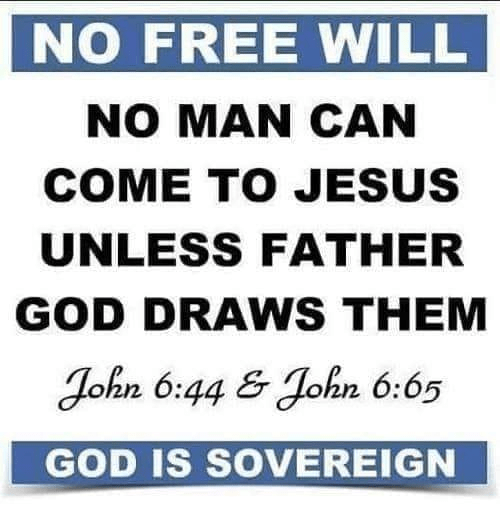
Some well-meaning Reformed chap wanted to draw attention to the fact that the Bible teaches monergism: that salvation is ultimately a work of God, and not a cooperation between God and the rebel sinner. I guess the point here is that it’s God’s will that makes all the difference when it comes to salvation, not our will. This is true because, aside from the grace of God, our wills are corrupted by our sinful nature. We certainly have a real will, but it’s not free to choose God because it simply doesn’t want God.
Jesus replied, “Very truly I tell you, everyone who sins is a slave to sin. (John 8:34 NIV)
“There is no one righteous, not even one;
there is no one who understands;
there is no one who seeks God.
All have turned away (Romans 3:10-12a; NIV)
I’m not a philosopher, but in light of what the Bible teaches (and my own experience) I would say this: our wills are free to the extent that they are constrained by our nature.
A few examples might help explain what I mean.
I might want to have the power to flap my arms and fly like a bird. But despite my will to do so, I am constrained by the fact that I am not a bird and have no physical attributes that would facilitate such an ability. My will is free to desire something, but not carry it out. Why? Because I don’t have the physical ‘nature’ of a bird. My will is constrained by my nature. I want something, but I can’t actually achieve it.
I might have the desire to eat very healthily and not eat sugary or fatty foods. But honestly, after a stressful day, I often find myself halfway through a block of chocolate. I have the will to eat healthily, but there are psychological and physiological habits which make it very hard for me to carry it out. My will is constrained by my nature as a person who loves sugary foods. I want something, but I have conflicting internal desires and motivations.
Let’s say I’m not a Christian. Can I just ‘sign up’ for being a Christian any time I choose? Not really. The Bible teaches that I am a sinner who is in rebellion against God. I’m not a ‘victim’, or an ambivalent observer of the world – I am incredibly biased, just like you are. I really don’t like the idea of God actually being, y’know . . . like God. I don’t, by nature, like him being in charge. I want to run my own life, thank you very much. My ‘heart’ – the seat of emotions and will – is not free in an absolute sense. In fact, when it comes to choosing God, my heart is (as Augustine said) incurvatus in se, “curved in on itself.”
In the examples above I think we see a few plain facts about our wills:
- Our wills are real. As sentient, self-aware creatures, we are able to make real choices. And yet . . .
- Our wills can choose or desire all manner of things, but we are limited in what our wills can really achieve. And sometimes we can’t choose things which are clearly in our best interests. Our wills are constrained by our limited, sometimes capricious, nature. In that sense they are not extensively free.
- There are some things that we really can’t choose at all, because we simply don’t want to choose them (which is what point 2 above is saying).
Basically, the meme I posted above could be a little unhelpful. It’s right that our wills are not free to just choose God any time we want. However, our wills are free in other, limited ways. But in all cases, our wills are constrained by what/who we really are.

 spes clara
You must be logged in to post a comment.